
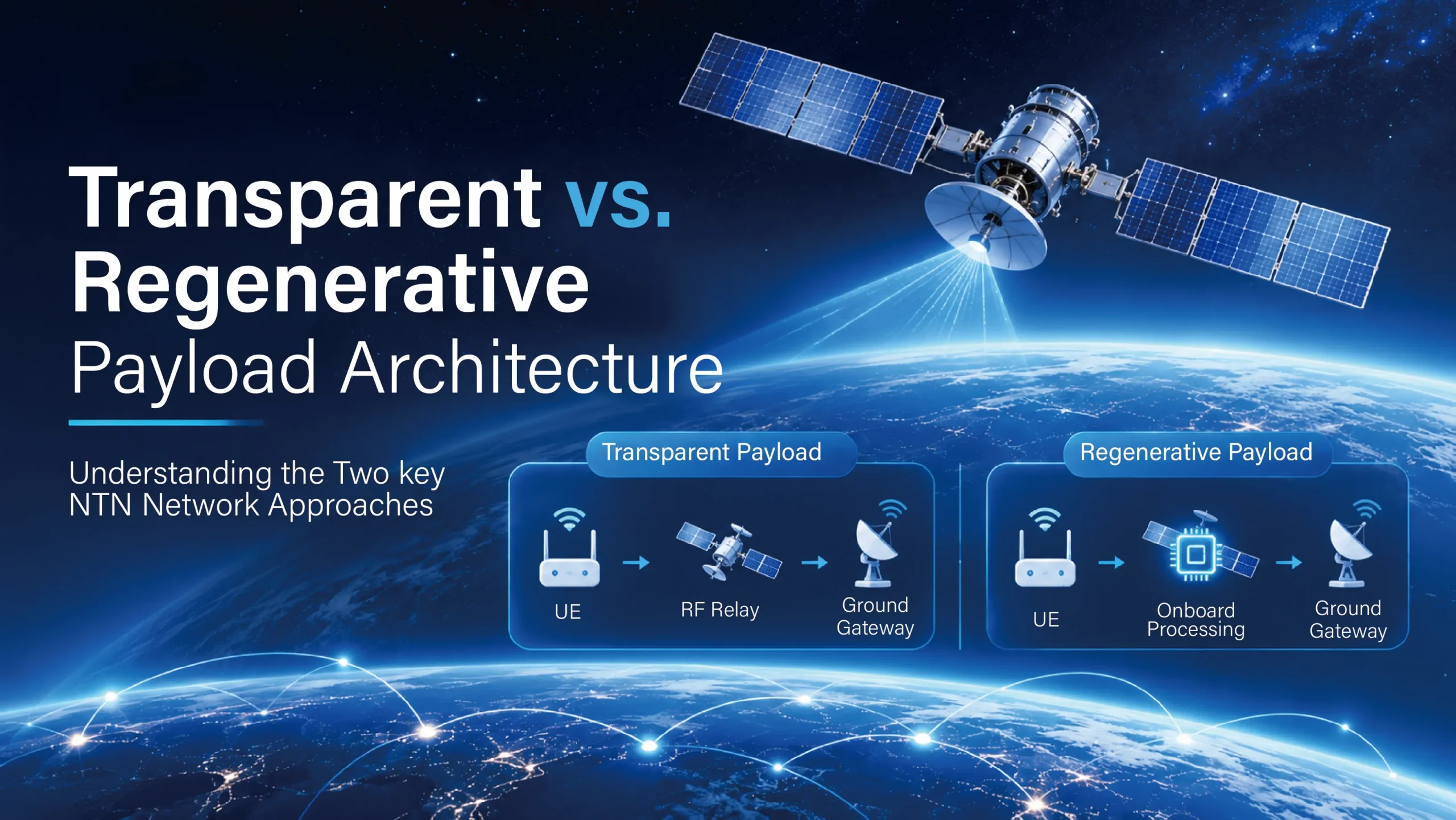
Transparent vs. Regenerative Payload Architecture: Understanding the Two Key NTN Network Approaches
How Satellite Payload Design Shapes 5G Non-Terrestrial Network Architecture and Deployment
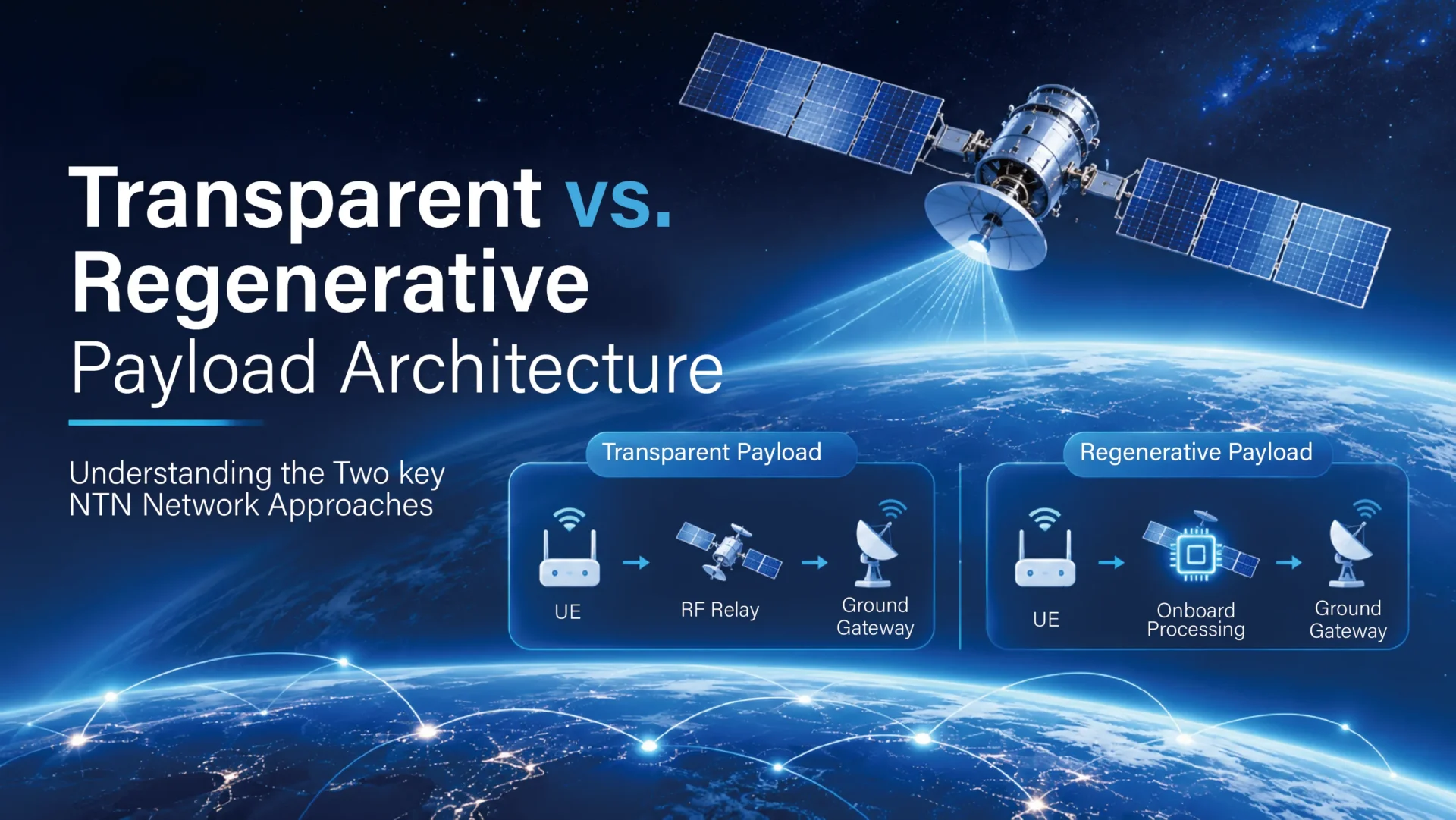
1. Introduction: The Architecture Behind Satellite Connectivity
As 5G Non-Terrestrial Networks (NTN) continue to evolve, satellite communication is playing an increasingly important role in expanding connectivity beyond the reach of traditional terrestrial networks.
However, satellite connectivity is shaped by more than the satellite itself. A key consideration is how communication and network processing functions are distributed between the space segment and ground infrastructure.
Two major satellite payload architectures are commonly discussed in NTN systems: Transparent Payload and Regenerative Payload.
These approaches determine where signal processing and radio access network(RAN) functions are performed. As a result, they influence satellite payload design, ground infrastructure requirements, and overall network deployment strategies.
Understanding the differences between these two architectures is essential for evaluating NTN solutions and planning future satellite-enabled connectivity systems.
2. What Is Transparent Payload Architecture?
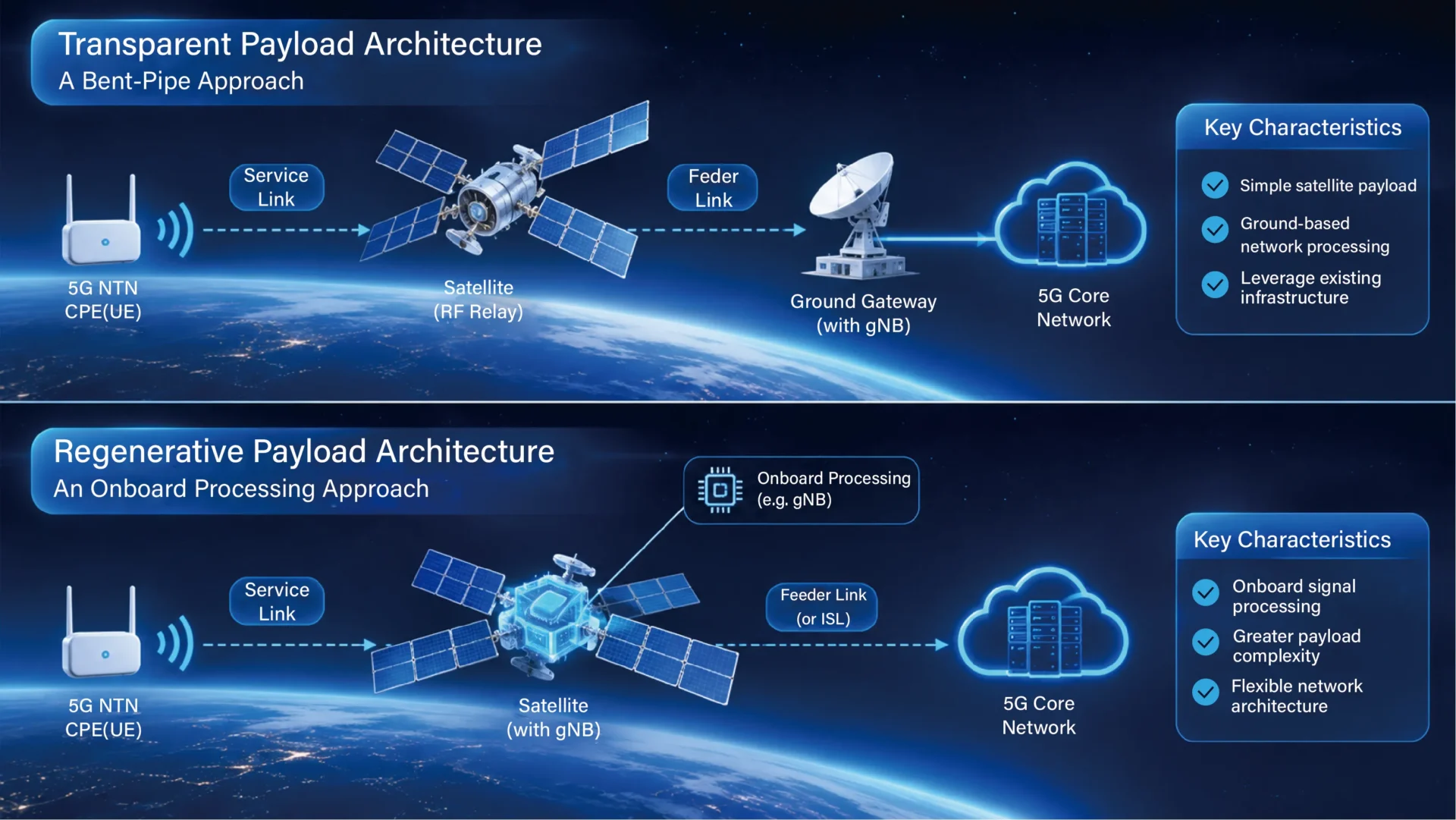
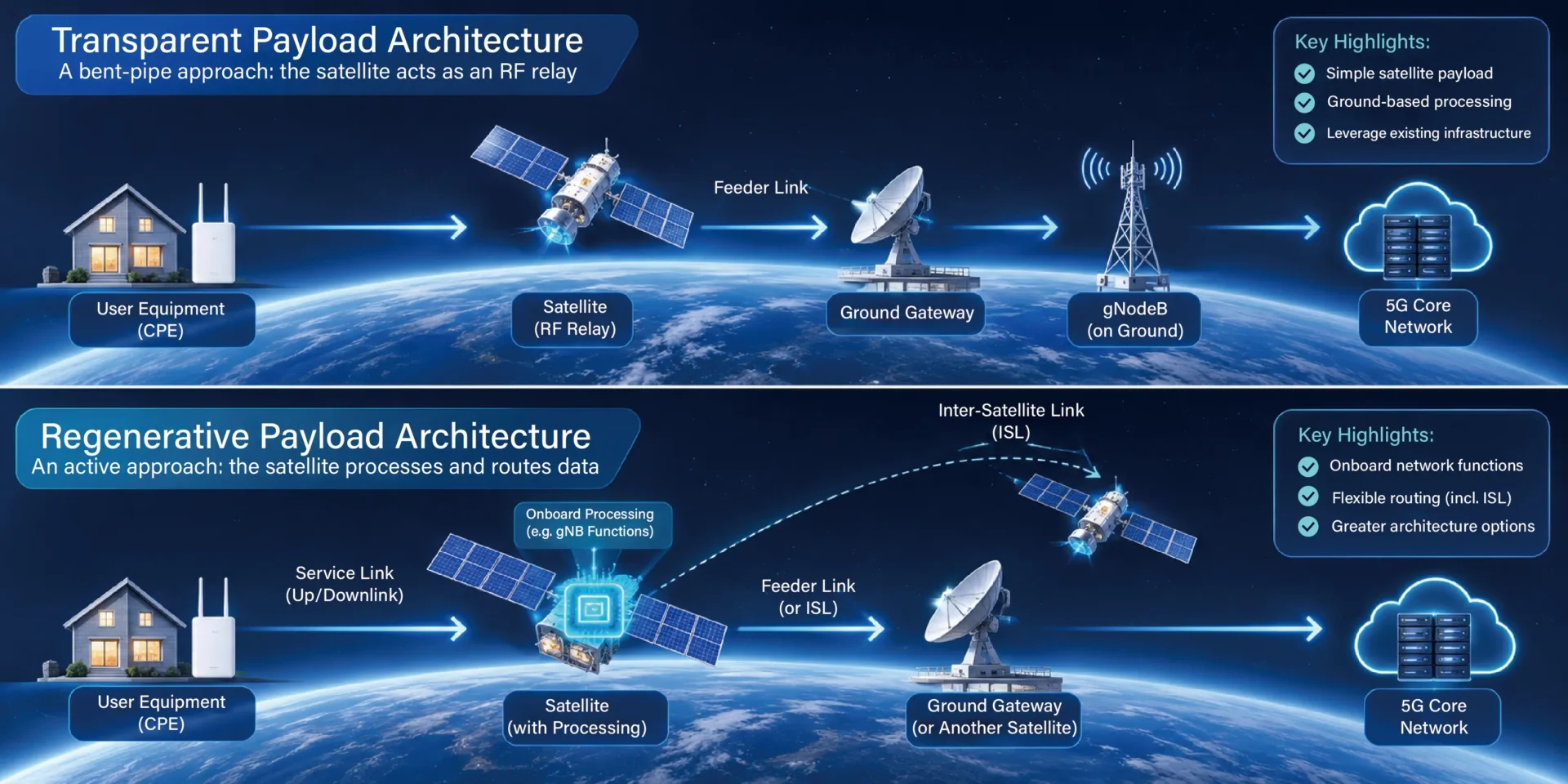
Transparent Payload Architecture, also known as a bent-pipe architecture, uses the satellite primarily as a radio frequency (RF) relay.
Rather than performing the main baseband processing functions onboard, the satellite receives signals from user equipment (UE), performs operations such as amplification and frequency conversion, and forwards the signals to a ground gateway.
Most network processing functions, including those performed by the gNodeB(gNB), remain on the ground.
How Does It Work?
-
Signal Transmission: User equipment transmits a signal to the satellite through the service link.
-
Signal Reception and Conversion: The satellite receives, amplifies, and frequency-converts the signal.
-
Signal Forwarding: The processed signal is forwarded to a ground gateway through the feeder link.
-
Ground-Based Processing: The ground-based gNB performs the relevant radio access network processing and communicates with the 5G Core Network.
The reverse process takes place during downlink communication, with signals transmitted from the ground toward the user equipment through the satellite.
Key Characteristics
-
Simpler Satellite Payload: Most complex baseband processing functions remain on the ground, reducing the processing requirements onboard the satellite.
-
Ground-Based Network Processing: The gNB and associated network functions are primarily hosted within terrestrial infrastructure.
-
Established Architecture: The design can leverage ground-based network equipment and established satellite RF relay technologies.
-
Dependence on Ground Gateways: Communication relies on suitable feeder links connecting the satellite with ground gateways.
Transparent payload architecture provides a practical approach to NTN deployment, particularly when keeping satellite payload complexity relatively low is a priority.
3. What Is Regenerative Payload Architecture?
Regenerative Payload Architecture takes a different approach by moving some or more signal processing functions from the ground segment to the satellite.
Depending on the implementation, a regenerative payload can perform onboard processing operations such as demodulation, decoding, and signal regeneration. In more advanced implementations, the satellite may also host radio access network functions, including gNB functions.
Rather than acting solely as an RF relay, the satellite becomes an active processing node within the NTN architecture.
How Does It Work?
-
Signal Reception: User equipment communicates with the satellite through the service link.
-
Onboard Signal Processing: The satellite processes the received signals using its onboard processing capabilities.
-
Network Function Processing: Where supported by the architecture, onboard gNB functions handle relevant radio access network operations.
-
Traffic Forwarding: Processed traffic is forwarded through the feeder link or, where supported, through inter-satellite links (ISLs) to other satellites or network gateways.
The specific distribution of processing and network functions depends on the satellite system design and implementation.
Key Characteristics
-
Onboard Processing: Signal processing functions are implemented on the satellite, with some architectures also supporting onboard gNB functions.
-
Greater Payload Complexity: Additional processing hardware and software, together with power and thermal management capabilities, are required.
-
Flexible Traffic Handling: Onboard processing and routing can enable more flexible traffic management and distributed network architectures.
-
Potential ISL Integration: Inter-satellite links can support traffic routing between satellites, potentially reducing the need for every communication path to pass through a nearby ground gateway.
By introducing more processing capabilities into the space segment, regenerative payload architecture creates opportunities for more distributed and flexible NTN network designs.
4. Transparent vs. Regenerative: Key Differences
Although both architectures support satellite-based network connectivity, their primary difference lies in where signal processing and network functions are performed.
|
Comparison |
Transparent Payload |
Regenerative Payload |
|
Satellite Role |
Primarily functions as an RF relay, forwarding signals between user equipment and ground infrastructure. |
Performs onboard signal processing and may also host network functions, depending on the implementation. |
|
Processing Location |
Most baseband and radio access network processing remains within ground infrastructure. |
Some or more processing functions are moved onboard, while other network functions remain on the ground. |
|
Satellite Complexity |
Generally involves lower onboard processing complexity, as most advanced processing functions are handled on the ground. |
Requires more sophisticated onboard processing capabilities, potentially increasing hardware, software, power, and thermal management requirements. |
|
Ground Infrastructure Requirements |
Relies heavily on ground-based gateways and gNB infrastructure to perform network processing. |
Still requires ground infrastructure, but processing functions can be distributed differently between the satellite and ground segments. |
|
Traffic Handling and Routing |
Signals are primarily relayed to ground infrastructure for further processing. |
Onboard processing can support more flexible traffic handling and routing within the satellite network. |
|
Inter-Satellite Link (ISL) Integration |
ISL integration may require additional architectural considerations, depending on the network design. |
Onboard processing can support ISL-based routing and communication between satellites where the system is designed to provide these capabilities. |
Neither architecture is universally better. Transparent payloads can be attractive when minimizing satellite complexity and relying on established ground-based processing infrastructure are priorities. Regenerative payloads can offer greater onboard processing capabilities and architectural flexibility, but require more sophisticated satellite systems.
The appropriate choice depends on network requirements, satellite capabilities, deployment costs, and operational considerations.



 English
 Français
 العربية
 Español
 日本語