
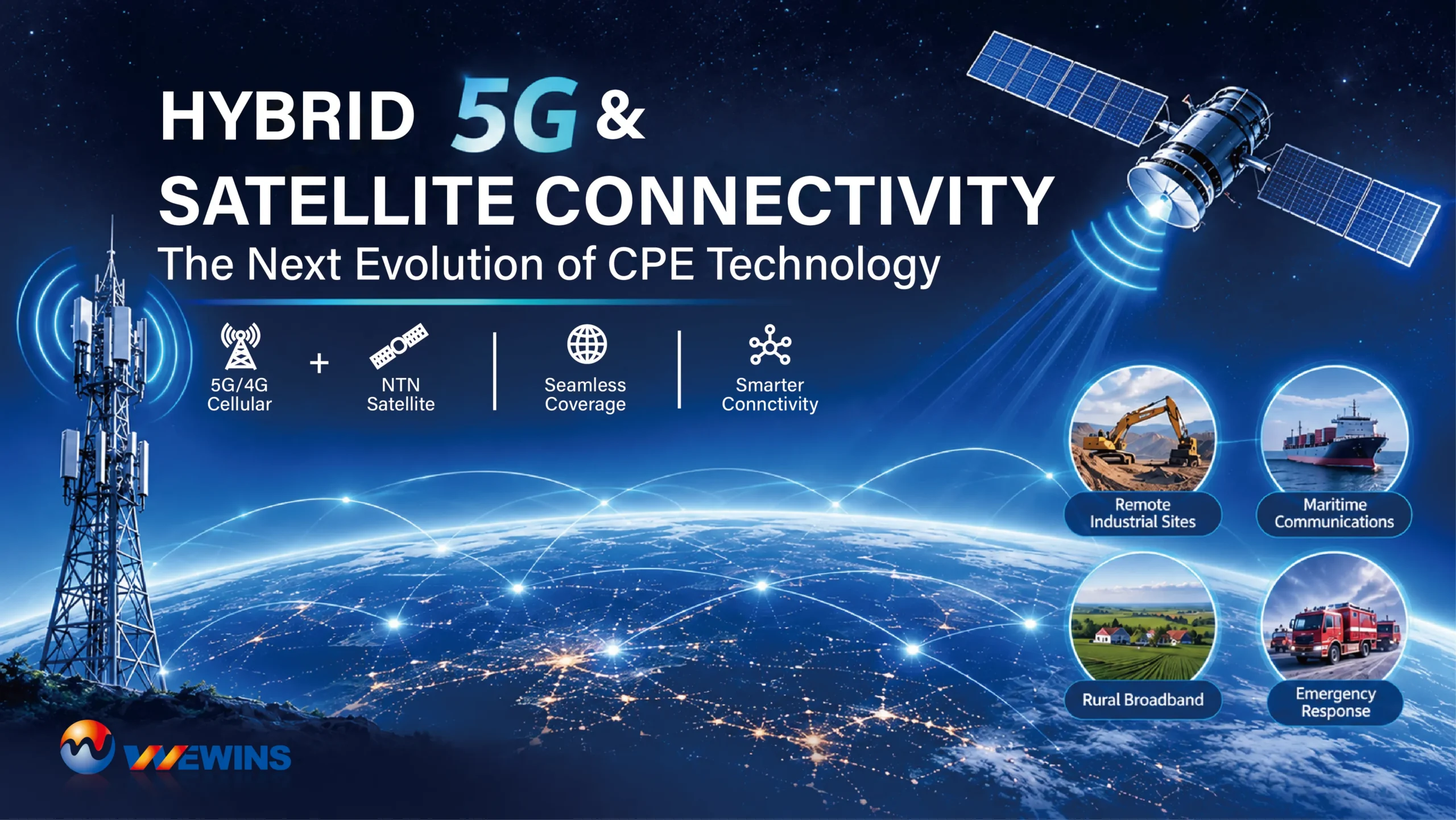
Exploring how cellular networks and satellite NTN technologies work together to extend broadband coverage and enable more flexible connectivity.
1. Introduction: Bringing Cellular and Satellite Networks Together
As global demand for reliable broadband connectivity continues to grow, extending network access beyond traditional cellular coverage has become an important focus foe the telecommunications industry.
While 4G LTE and 5G networks provide high-speed connectivity across cities, towns, and many populated areas, network deployment in remote regions, offshore environments, and geographically challenging locations can still be costly and difficult.
Satellite communication offers another way to extend connectivity beyond the reach of terrestrial infrastructure.
With the development of 3GPP Non-Terrestrial Network (NTN) standards, particularly Release 17 and subsequent enhancements in Releases 18 and 19, the integration of satellite and terrestrial communication technologies is creating new opportunities for hybrid connectivity solutions.
One emerging approach is Dual-Mode CPE, which combines 5G/4G cellular connectivity and satellite NTN capabilities within a single device.
By integrating terrestrial and non-terrestrial networks, dual-mode CPE aims to provide high-speed cellular access where available and extend network connectivity through satellite links when terrestrial coverage becomes limited.
This approach represents an important step toward more flexible, intelligent, and extensive broadband connectivity.
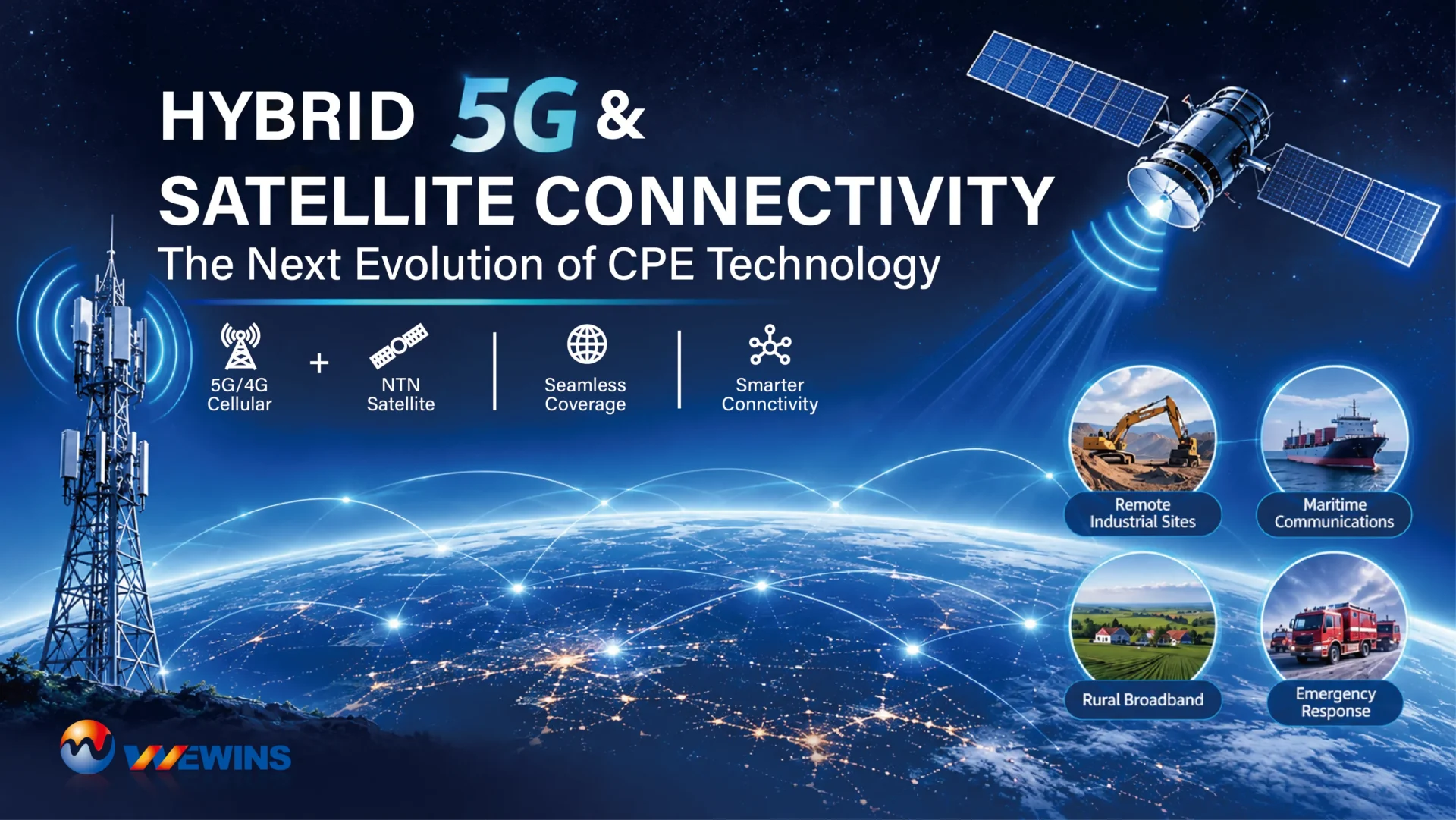
2. Why Hybrid 5G and Satellite Connectivity Matters
Traditional cellular networks depend on terrestrial infrastructure, including base stations and supporting transmission systems. Although these networks deliver excellent performance in many populated areas, extending coverage to remote locations can require significant investment.
Satellite networks provide an alternative connectivity path, particularly in areas where terrestrial infrastructure is unavailable or difficult to deploy.
However, relying entirely on satellite connectivity may not always be the most cost-effective option, especially when terrestrial networks are already available.
Combining cellular and satellite technologies offers a more flexible approach.
Key advantages of hybrid connectivity include:
-
Extended Network Coverage: Cellular connectivity serves areas covered by terrestrial networks, while satellite links can help extend access beyond traditional coverage boundaries.
-
Flexible Network Selection: The device can select an appropriate connection path based on signal conditions, latency, service costs, and Quality of Service (QoS) requirements.
-
Optimized Connectivity Costs: Where suitable terrestrial coverage is available, cellular networks can be prioritized to help reduce reliance on potentially more expensive satellite services.
-
Improved Network Resilience: Satellite connectivity can provide an alternative communication path when terrestrial infrastructure is unavailable or disrupted.
-
Unified Device Management: Integrated management capabilities can support network monitoring, configuration, and remote maintenance.
For telecommunications operators, ISPs, and enterprise customers, this hybrid model creates new possibilities for delivering broadband services across different environments.
3. Understanding Dual-Mode CPE Architecture
A dual-mode CPE combines cellular and satellite communication capabilities within a unified device architecture.
The proposed design can be organized into four major functional components: cellular RF, satellite RF, digital baseband and protocol processing, and intelligent routing.
3.1 Cellular RF Front End
The cellular subsystem supports 5G NR and 4G LTE connectivity.
Depending on the target market and product configuration, the cellular RF front end can support Sub-6 GHz frequency bands, such as n77, n78, and n79, as well as millimeter-wave bands where required.
Advanced antenna configurations, including 4×4 MIMO and high-gain antenna designs, can help improve signal reception and transmission performance.
This subsystem provides the primary broadband connection wherever compatible terrestrial cellular networks are available.
3.2 Satellite RF Front End
The satellite communication subsystem enables connectivity with compatible Non-Terrestrial Networks.
The proposed architecture references NTN frequency bands such as:
-
n255: L-band, with an uplink frequency range of 1626.5–1660.5 MHz.
-
n256: S-band, with an uplink frequency range of 1980–2010 MHz.
Satellite antenna design is an important consideration in this subsystem. Circular polarization, RF isolation, antenna gain, and signal acquisition capabilities all influence satellite communication performance.
For outdoor configurations, antenna solutions may incorporate circularly polarized antennas with appropriate gain characteristics to support satellite signal reception and transmission.
3.3 Digital Baseband and Protocol Stack
The digital baseband handles signal processing and communication protocols for cellular and satellite connectivity.
An NTN-compatible chipset and a protocol stack designed to support applicable 3GPP specifications are essential components of the proposed architecture.
Integrating the communication functions within a coordinated system architecture can help simplify device operation, network coordination, and management.
Chipset selection, protocol compatibility, and implementation requirements need to be evaluated according to the intended satellite network and device configuration.
3.4 Intelligent Switching and Routing
The intelligent routing module coordinates network selection and traffic management between cellular and satellite connections.
Using policy-based routing, the device can select an appropriate network path according to signal strength, latency, data costs, and application requirements.
For example:
-
Latency-sensitive applications, such as VoIP and video conferencing, can prioritize a suitable lower-latency connection.
-
High-volume data traffic can be directed through an appropriate high-capacity network.
-
Cellular connectivity can be prioritized when available and suitable, while satellite connectivity can serve as an alternative when terrestrial coverage becomes insufficient.
Remote management protocols such as TR-369 USP and TR-069 can also support device monitoring, configuration, link management, and usage analysis.
Together, these capabilities provide the foundation for more intelligent and flexible network connectivity.
4. Key Technical Challenges in Dual-Mode CPE Development
Although combining cellular and satellite communication offers significant opportunities, developing a reliable dual-mode CPE involves several technical challenges.
4.1 Frequency Coexistence and RF Isolation
Cellular and satellite communication systems operate across different frequency bands and may require multiple RF components within one device.
The design must carefully manage potential interference between the two communication subsystems.
Appropriate antenna placement, RF isolation, filtering, and electromagnetic compatibility testing are essential to maintaining stable communication performance.
4.2 Doppler Compensation and Timing Advance
Low Earth Orbit (LEO) satellites travel at orbital speeds of approximately 7.8 km/s.
Their high speed creates Doppler frequency shifts and rapidly changing signal propagation delays, introducing additional requirements for signal synchronization and communication processing.
According to relevant NTN technical considerations, including 3GPP TR 38.821, satellite communication terminals may require frequency-offset compensation and timing-advance mechanisms.
GNSS-based positioning and synchronization can support these processes by helping the terminal account for satellite movement and changing propagation conditions.
These functions are important engineering considerations when developing reliable LEO satellite communication terminals.
4.3 Intelligent Network Switching and Service Continuity
Switching between terrestrial and satellite networks requires coordination between the device, communication protocols, and network infrastructure.
A suitable switching strategy needs to consider:
-
Cellular signal strength and network availability.
-
Satellite link availability.
-
Network latency and traffic requirements.
-
Quality of Service (QoS) policies.
-
Data usage and service costs.
Make-before-break switching mechanisms can be considered to help maintain active communication sessions during network transitions.
However, achieving uninterrupted service depends on the implementation, network architecture, and support provided by the relevant cellular and satellite networks.
4.4 Antenna Selection and Integration
Satellite communication introduces different antenna requirements compared with conventional terrestrial cellular devices.
Circular polarization, suitable antenna gain, and effective satellite signal acquisition are important design considerations.
Depending on the device form factor and deployment environment, potential antenna solutions include:
-
Electronically steered phased-array antennas.
-
Mechanically adjustable antenna systems.
-
Integrated patch or helical antenna arrays.
The final design needs to balance antenna performance, device size, power consumption, installation requirements, and operating environment.
5. Applications of Hybrid 5G and Satellite CPE
The integration of cellular and satellite networks can support a wide range of connectivity requirements across different industries.
5.1 Remote Industrial Sites
Mining operations, oil and gas exploration, and remote construction projects often take place in locations with limited terrestrial network coverage.
Dual-mode CPE can provide a potential connectivity solution for:
-
VoIP and business communications.
-
VPN access and remote operations.
-
Cloud application synchronization.
-
IoT sensor data transmission.
By combining cellular and satellite connectivity, businesses can explore more flexible network access options for geographically isolated operations.
5.2 Maritime and Offshore Communications
Commercial vessels, offshore wind farms, and marine aquaculture operations require connectivity across changing coverage environments.
In coastal areas, 5G and 4G networks can provide terrestrial broadband access. Farther offshore, satellite communication can help extend connectivity beyond the reach of cellular infrastructure.
A hybrid connectivity solution can select suitable network paths according to coverage conditions and service requirements, potentially helping operators optimize communication costs.
5.3 Rural Broadband Connectivity
Providing broadband access to underserved rural communities remains a challenge in many regions.
Building additional terrestrial infrastructure can involve significant investment, particularly in areas with low population density or difficult terrain.
Satellite connectivity can complement existing cellular networks, providing regional operators and Internet Service Providers (ISPs) with another option for extending broadband access.
Dual-mode CPE can help create more flexible connectivity solutions for rural and underserved markets.
5.4 Emergency and Disaster Response
Natural disasters and other emergencies can damage terrestrial communication infrastructure, disrupting essential connectivity.
Satellite-enabled CPE can provide an alternative communication path for emergency response teams, temporary command centers, and field operations.
Potential applications include emergency communications, coordination between response teams, and temporary broadband access in affected areas.
By combining terrestrial and satellite network capabilities, hybrid CPE can contribute to more resilient communication infrastructure.
6. The Future of Hybrid Connectivity
The development of 3GPP NTN standards is creating a technical foundation for closer integration between terrestrial and non-terrestrial networks.
As satellite communication technologies, cellular chipsets, antenna systems, and intelligent network management capabilities continue to evolve, hybrid connectivity is expected to create new opportunities for the telecommunications industry.
For network operators, device manufacturers, and system integrators, this evolution offers several potential opportunities:
-
Expanding broadband coverage into underserved and remote areas.
-
Developing new connectivity services for maritime and industrial applications.
-
Improving network resilience through alternative communication paths.
-
Creating more flexible CPE architectures for different deployment environments.
-
Supporting new business opportunities through terrestrial and satellite network integration.
At the same time, commercial deployment requires careful consideration of standards compliance, satellite network compatibility, spectrum regulations, device certification, network operator support, and service economics.
The future of hybrid connectivity will involve more than simply adding satellite functionality to existing CPE devices. It will require coordinated development across hardware, software, network infrastructure, and service management.
 English
 Français
 العربية
 Español
 日本語