
As Mobile Broadband (MBB) devices continue to evolve, storage technology plays an increasingly important role in delivering reliable performance, fast startup, and seamless software management. Whether it’s a 5G CPE, 4G LTE router, industrial gateway, or IoT terminal, every device depends on embedded flash memory to store its operating system, firmware, configuration files, and user data.
Among the available non-volatile memory technologies, NAND Flash and NOR Flash are the two most widely used solutions. While both retain data even when power is removed, they serve different purposes within embedded communication devices.
This article explains the differences between NAND Flash and NOR Flash, their advantages, common applications in MBB products, and why most modern wireless devices use both technologies together.
What Is NOR Flash?
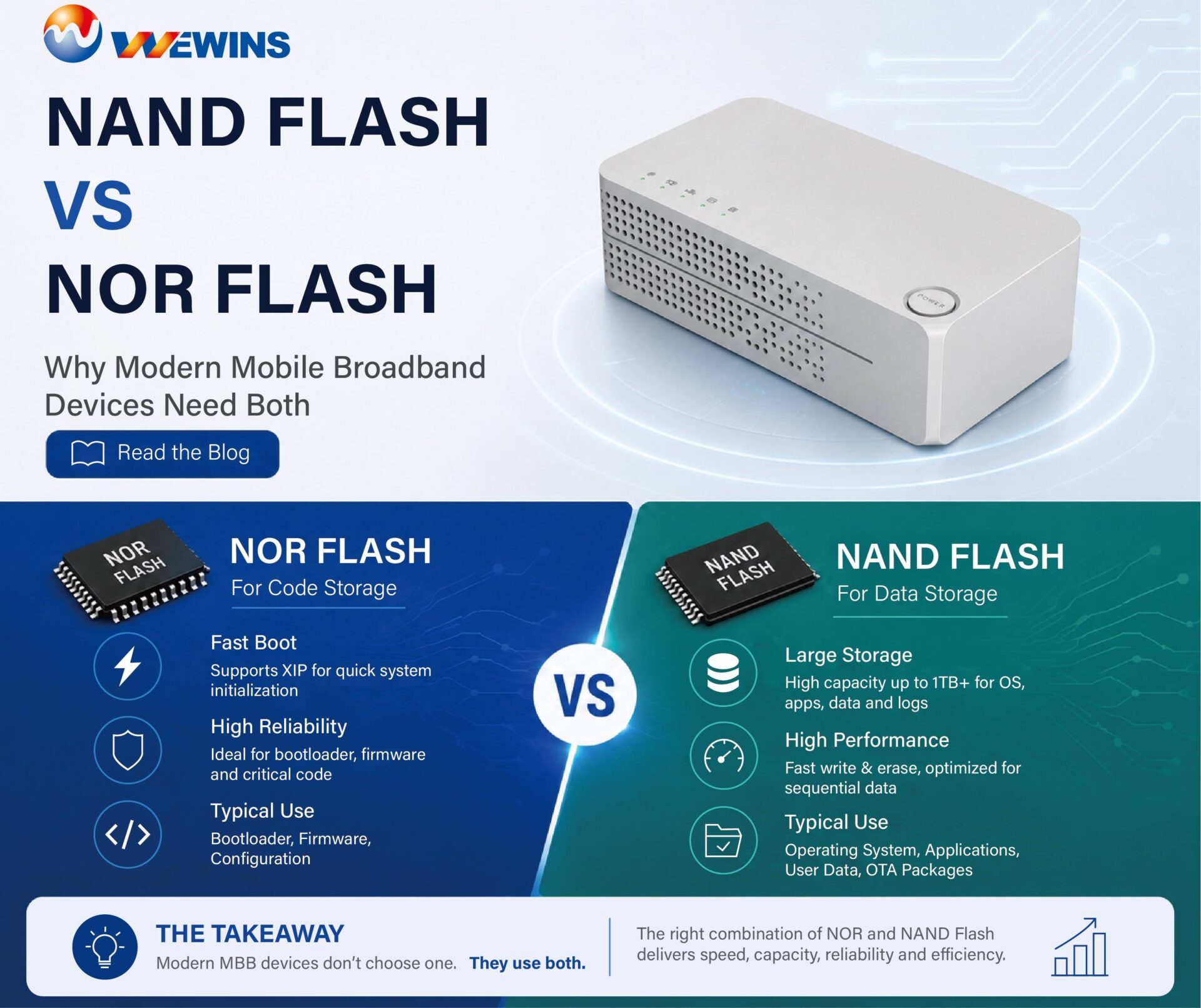
NOR Flash is designed for fast random read access and supports Execute In Place (XIP), allowing processors to execute code directly from the flash memory without first loading it into RAM. This capability makes NOR Flash ideal for storing mission-critical software that must be accessed immediately during system startup.
Because of its reliability and fast read performance, NOR Flash is commonly used for storing:
- Bootloader
- System firmware
- Device configuration parameters
- Security certificates and keys
- Recovery firmware
In Mobile Broadband devices, NOR Flash helps ensure quick boot times and stable system initialization, making it a critical component for reliable operation.
Advantages of NOR Flash
NOR Flash offers several benefits for embedded communication devices:
- Fast random read performance for immediate code execution
- Execute In Place (XIP) support, reducing boot time
- High reliability with long erase and write endurance
- Excellent data integrity for critical firmware storage
- Stable performance in industrial and long-life applications
Limitations
Despite its advantages, NOR Flash also has some limitations:
- Relatively small storage capacity
- Higher cost per gigabyte compared to NAND Flash
- Slower write and erase operations
For these reasons, NOR Flash is generally reserved for code storage rather than large data storage.
What Is NAND Flash?
Unlike NOR Flash, NAND Flash is optimized for high-density data storage and fast sequential read/write performance. It provides significantly larger storage capacity at a much lower cost, making it the preferred choice for storing operating systems and large amounts of user data.
In Mobile Broadband products, NAND Flash typically stores:
- Linux operating system
- Application software User configuration files
- System logs
- Firmware update packages (OTA/FOTA)
- Cache and temporary data
As communication devices become more intelligent and feature-rich, NAND Flash provides the storage capacity required for increasingly complex software environments.
Advantages of NAND Flash
NAND Flash is widely adopted because it offers:
- High storage density
- Lower cost per bit
- Fast write and erase performance
- Excellent scalability for large-capacity storage
- Advanced 3D NAND technology for improved efficuency
Limitations
Compared with NOR Flash, NAND Flash has several challenges:
- Requires Error Correction Code (ECC)
- Needs bad block management
- Does not support Execute In Place (XIP)
- Lower write endurance depending on flash type (SLC, MLC, TLC, or QLC)
These limitations are typically managed by the storage controller and embedded software.
NAND Flash vs NOR Flash: Key Differences
|
Feature |
NOR Flash |
NAND Flash |
|
Primary Purpose |
Code storage |
Data storage |
|
Storage Capacity |
Low |
High |
|
Read Performance |
Excellent random read |
Excellent sequential read |
|
Write Speed |
Moderate |
Fast |
|
Execute In Place (XIP) |
Supported |
Not supported |
|
ECC Required |
Usually no |
Yes |
|
Cost per GB |
Higher |
Lower |
|
Typical Applications |
Bootloader, firmware, configuration |
Operating system, applications, user data, logs |
Rather than competing with each other, NAND Flash and NOR Flash complement one another by handling different storage tasks within the same device.
Why Modern MBB Devices Use Both NAND and NOR Flash
Most modern Mobile Broadband devices combine both storage technologies to achieve the best balance between speed, reliability, capacity, and cost.
A typical storage architecture looks like this:
NOR Flash
- Bootloader
- Startup firmware
- Recovery firmware
- Device configuration
NAND Flash
- Linux operating system
- Application software
- User files
- Log data
- OTA firmware packages
This hybrid architecture allows devices to boot quickly while still providing sufficient storage for advanced networking features and software updates.
Storage Recommendations for Different MBB Devices
Different communication products have different storage requirements depending on their deployment environments.
|
Device Type |
Recommended Storage Solution |
|
4G LTE Router |
NOR Flash + NAND Flash |
|
5G Indoor CPE |
NOR Flash + eMMC/UFS |
|
Outdoor 5G CPE |
Industrial NOR Flash + Industrial eMMC |
|
Industrial IoT Gateway |
Industrial NOR Flash + SLC NAND |
|
Enterprise Router |
NOR Flash + High-Capacity NAND |
Industrial deployments often prioritize long-term reliability, while consumer products typically focus on achieving the best balance between cost and performance.
Future Trends in Embedded Storage
As Mobile Broadband technology continues ti evolve alongside 5G and edge computing, embedded storage is also advancing repidly.
Some of the key trends include:
- Large-capacity NOR Flash for increasingly sophisticated firmware
- Higher-density 3D NAND enabling more powerful embedded operating systems
- Lower power consumption for energy-efficient wireless devices
- Faster over-the-air (OTA) firmware updates
- Improved storage reliability for industrial and mission-critical applications
Emerging memory technologies such as MRAM and ReRAM are attracting attention for specialized applications, but NAND and NOR Flash remain the dominant storage solutions for today’s Mobile Broadband devices.
Conclusion
Selecting the appropriate storage architecture is essential for building reliable, high-performance Mobile Broadband devices. NOR Flash delivers fast startup and dependable firmware storage, while NAND Flash provides the capacity needed for operating systems, applications, and user data.
By combining both technologies, manufacturers can optimize system performance, improve reliability, and reduce overall costs-meeting the growing demands of modern 4G LTE , 5G FWA, and IoT connectivity.
At Wewins, we design our Mobile Broadband solutions with optimized embedded storage architectures to ensure stable operation, efficient firmware management, and long-term reliability. From 5G CPEs and 4G LTE routers to industrial gateways and customized wireless solutions, our products are engineered to deliver dependable connectivity across a wide range of deployment scenarios.




 English
  Français
  العربية
  Español