
vSIM Technology in Mobile Broadband: Enabling More Flexible Connectivity
As mobile broadband continues to expand into new markets and deployment scenarios, connectivity devices are facing increasingly diverse requirements. Traditional physical SIM cards remain widely used, but they can introduce limitations when devices need to support flexible network selection, remote connectivity management, or multiple operator services.
This is where vSIM (Virtual SIM) technology provides a different approach.
By implementing SIM functionality through software rather than relying on a physical SIM card, vSIM can provide greater flexibility for Mobile Broadband (MBB) devices such as MiFi routers, CPEs, and other connected devices.
For device manufacturers, operators, and connectivity service providers, vSIM can become more than a replacement for a physical SIM. It can serve as part of a broader connectivity strategy, helping devices adapt to different network environments and market requirements.
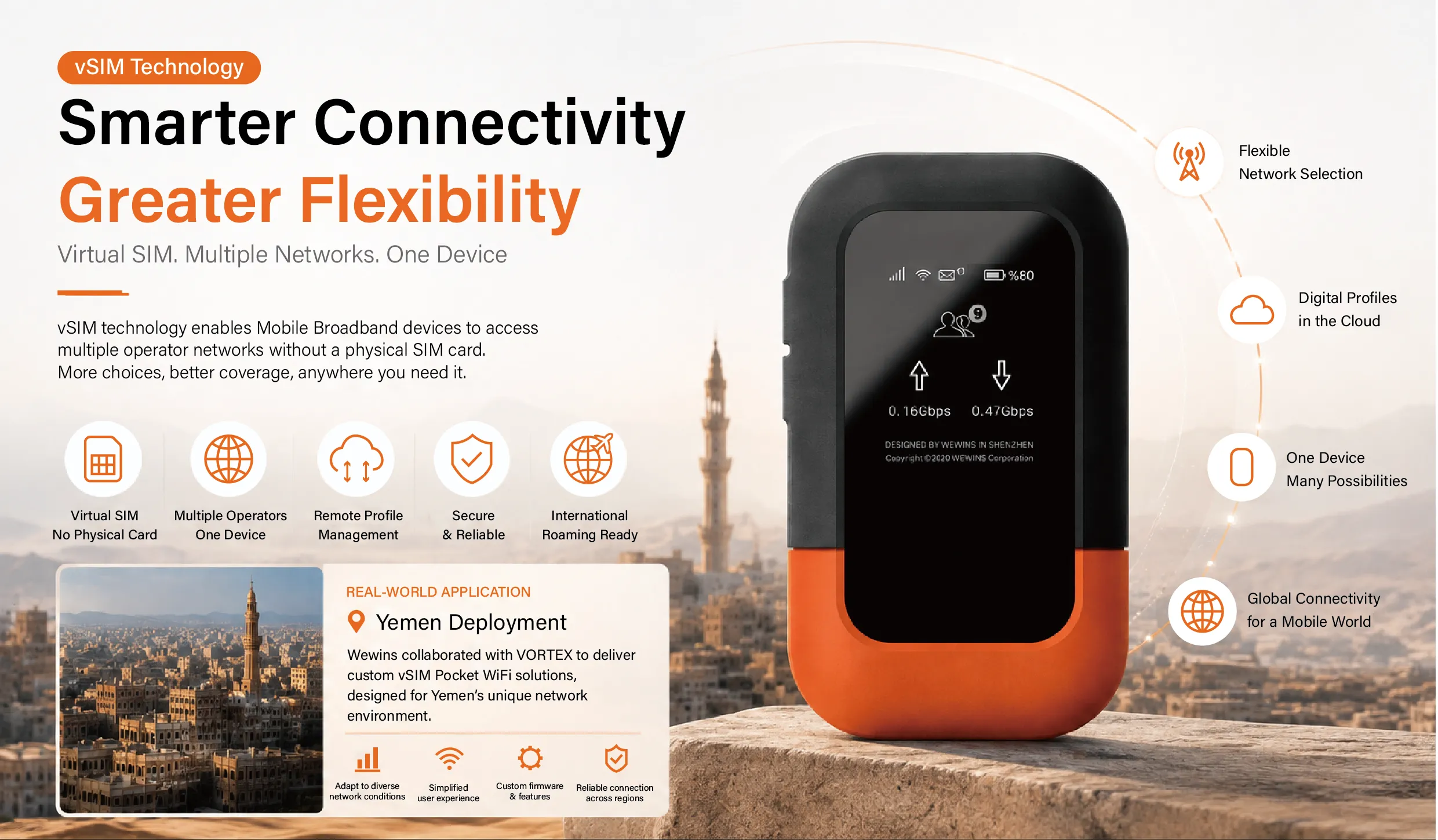
Wewins has applied this approach in real-world Mobile Broadband projects. One example is the customized vSIM-based Pocket WiFi deployment developed with VORTEX for the Yemen market, where flexible connectivity and device customization were used to address challenging local network conditions.
What Is vSIM Technology?
vSIM, short for Virtual SIM, is a software-based approach implementing SIM functionality.
Unlike a traditional physical SIM card, vSIM does not require a removable SIM card to provide SIM-related functionality. Instead, the SIM function is implemented through software and the interaction between the device’s baseband and operating system.
This creates a different architecture from conventional SIM-based connectivity.
With a physical SIM, subscriber information such as operator information, subscription details, and IMSI-related data is stored on the physical SIM card. With vSIM, the relevant information can be managed digitally, allowing the device to access and activate connectivity profiles through network-based processes.
The result is a more flexible connectivity model that can reduce the device’s dependence on physical SIM cards.
vSIM vs. eSIM: What Is the Difference?
vSIM and eSIM are sometimes discussed together because both reduce the need for users to physically replace SIM cards. However, they are based on different implementation approaches.
|
Feature |
vSIM |
eSIM |
|
Implementation |
Software-based |
Hardware-based |
|
Physical SIM Card |
Not required |
Not required |
|
SIM Function |
Implemented through software and system integration |
Implemented through an embedded SIM component |
|
Network Profile Management |
Software/network-based |
eSIM profile management |
|
Device Flexibility |
High |
High |
|
Typical Applications |
MiFi, CPE, IoT, MVNO solutions |
Smartphones, IoT, MBB and other connected devices |
The key distinction is that vSIM is a software-based implementation, while eSIM uses an embedded hardware component to provide SIM functionality.
Both technologies can reduce reliance on physical SIM cards, but they may be selected according to different hardware architectures, connectivity models, and deployment requirements.
Why Does vSIM Matter for Mobile Broadband?
Mobile Broadband devices are increasingly being deployed in environments where connectivity requirements vary significantly from one market to another.
A single device may need to operate across different networks, support multiple connectivity plans, or adapt to regional network conditions.
For MiFi and CPE products, vSIM can provide several potential advantages.
1. More Flexible Network Selection
One of the key advantages of vSIM is the ability to support digital network profile management without requiring users to physically replace a SIM card.
This can be particularly useful in markets where network coverage varies between regions.
Instead of relying on a single physical SIM card, a vSIM-enabled device can support a more flexible approach to network selection and connectivity management.
2. Simplified User Experience
Physical SIM cards require users to obtain, insert, remove, and replace cards when changing operators or plans.
A software-based approach can simplify this process by allowing connectivity profiles to be managed digitally.
For Pocket WiFi and other portable broadband devices, this can reduce operational complexity and make connectivity easier for end users.
3. Support for Multiple Connectivity Options
vSIM technology can enable a device to support multiple operator profiles or connectivity plans.
This is particularly relevant for applications where users may need to switch between networks based on coverage, availability, or service requirements.
For operators and service providers, this also creates opportunities to develop more flexible connectivity packages.
4. Reduced Dependence on Physical SIM Cards
Removing the need for a physical SIM card can simplify device design and reduce the operational processes associated with SIM production, distribution, replacement, and installation.
For large-scale deployments, reducing these physical dependencies can help streamline device provisioning and connectivity management.
5. Support for International Connectivity
vSIM technology can also support international connectivity scenarios.
According to the vSIM technology material, users can activate corresponding virtual SIM services when traveling between regions, potentially allowing them to access local connectivity services without physically changing SIM cards.
This makes the technology particularly relevant to portable connectivity products and international use cases.
How vSIM Can Be Used in MiFi and CPE Devices
MiFi and CPE devices are particularly suitable for exploring the value of vSIM technology.
A traditional Mobile Broadband architecture often depends on a physical SIM card:
Physical SIM → Modem/Baseband → Mobile Network → Internet
A vSIM-based architecture can instead introduce a digital connectivity layer:
vSIM / Digital Connectivity Profile → Device Software & Baseband → Mobile Network → Internet
This architecture provides greater flexibility for managing connectivity profiles and adapting devices to different deployment environments.
For operators, brands, and service providers, this means the device can become part of a broader connectivity solution rather than simply acting as a hardware terminal.
vSIM for Different Mobile Broadband Scenarios
The flexibility of vSIM makes it suitable for a variety of applications.
MiFi and Pocket WiFi
Portable WiFi devices can use vSIM technology to provide flexible connectivity without requiring users to manually change physical SIM cards.
4G and 5G CPE
Fixed wireless access devices can potentially benefit from flexible network profile management, particularly in markets with multiple operators or variable network coverage.
IoT Devices
For connected devices deployed across different regions, software-based connectivity can simplify device provisioning and management.
Enterprise Connectivity
Organizations can explore centralized connectivity management for employee devices and business connectivity solutions.
MVNO Services
Mobile Virtual Network Operators can use virtualized SIM technology as part of flexible connectivity and service models.
These applications reflect the broader potential of vSIM beyond traditional consumer mobile devices.
Real-World Application: vSIM Pocket WiFi Deployment in Yemen
The value of a connectivity technology is ultimately demonstrated by how well it performs in real deployment environments.
A strong example is Wewins’ collaboration with VORTEX in Yemen.
VORTEX is a Pocket WiFi brand and distributor in the Yemen market, serving both consumer and SME segments. According to the case study, the local market presents significant connectivity challenges, including regional differences in network coverage, limitations of conventional SIM-based solutions, and strong user sensitivity to cost, reliability, and ease of use.
In some areas, fixed-line broadband is unavailable or impractical, while mobile network performance can vary significantly. Standard Pocket WiFi products designed for more mature markets therefore had difficulty adapting to these conditions.
For VORTEX, simply supplying standard hardware was not enough. The project required a connectivity solution designed around the realities of the local market.
A Customized vSIM-Based Approach
Wewins worked with VORTEX to develop a customized vSIM-based Mobile Broadband solution specifically for the Yemen market.
The solution combined vSIM technology with flexible firmware customization to support:
- Dynamic network selection without relying on physical SIM cards
- Improved adaptability across regions with different network coverage
- A simplified user experience in constrained network environments
Multiple Pocket WiFi models-including M47, M51, M54, and M55-were customized for different user profiles and application scenarios, ranging from individual consumers to small and medium-sized businesses.
This project demonstrates an important point: the value of vSIM is not simply the removal of a physical SIM card. Its greater value comes from combining connectivity technology, device hardware, firmware, and market-specific customization into a complete solution.
From Hardware Supplier to Solution Partner
The Yemen project also highlights the importance of customization in Mobile Broadband deployments.
Instead of applying a standard product model, Wewins worked with VORTEX to align device capabilities, firmware behavior, and connectivity architecture with real-world usage scenarios.
According to the case study, this scenario-driven approach helped:
- Reduce deployment complexity
- Simplify end-user operation
- Improve overall service stability
- Support a commercially viable Pocket WiFi portfolio
The customized solution enabled VORTEX to expand its Pocket WiFi offerings across Yemen and provide mobile broadband services to users who were previously underserved by conventional connectivity models.
The project also demonstrated how local market knowledge and flexible ODM capabilities can be combined to create connectivity solutions for challenging environments.
Read the full case study:
Wewins & VORTEX | Custom vSIM Pocket WiFi Deployment in Yemen
What Does vSIM Mean for the Future of Mobile Broadband?
As Mobile Broadband continues to expand into emerging markets, enterprise applications, and IoT scenarios, connectivity solutions need to become more flexible.
vSIM provides one potential path toward this evolution.
Instead of treating the SIM card as a fixed physical component, vSIM introduces a software-based approach that can make connectivity profiles more flexible and manageable.
For operators and service providers, this can create opportunities to:
- Simplify device provisioning
- Support multiple connectivity profiles
- Improve network selection flexibility
- Reduce dependence on physical SIM logistics
- Develop new connectivity service models
- Adapt devices to different regional requirements
At the same time, vSIM adoption also requires careful consideration of areas such as network security and user privacy. These remain important challenges as the technology develops.
The long-term value of vSIM will therefore depend not only on the technology itself, but also on how effectively hardware manufacturers, operators, MVNOs, and connectivity providers integrate it into complete service ecosystems.
How Wewins Supports Customized vSIM Solutions
vSIM is only a component of a complete Mobile Broadband solution.
For commercial deployments, successful implementation may require coordination between:
- Hardware design
- Baseband integration
- Firmware development
- Connectivity architecture
- Network profile management
- User experience
- Market-specific customization
Wewins combines Mobile Broadband hardware development with flexible ODM and firmware customization capabilities to help partners build solutions around specific market requirements.
Our Mobile Broadband portfolio includes MiFi routers, 4G LTE CPEs, 5G CPEs, and other wireless connectivity devices, providing a flexible hardware foundation for customized connectivity solutions.
The Yemen project with VORTEX demonstrates how this approach can be applied in a real-world market: rather than offering a standard device, Wewins worked with the local partner to integrate vSIM technology and firmware customization around specific network and user requirements.
Conclusion
vSIM represents a different approach to mobile connectivity by moving SIM functionality from a traditional physical card toward a software-based model.
For Mobile Broadband products such as MiFi and CPE devices, this can provide greater flexibility in network selection, connectivity management, and device customization.
However, the real value of vSIM comes from how it is integrated into a complete solution.
The Wewins and VORTEX Yemen project is one example of how vSIM, firmware customization, and market-specific product design can be combined to address connectivity challenges in a complex deployment environment.
As more operators, MVNOs, brands, and service providers look for flexible connectivity solutions, technologies such as vSIM may play an increasingly important role in the evolution of Mobile Broadband.
For businesses looking to develop customized MiFi, CPE, or other wireless connectivity products, Wewins provides the hardware development, ODM customization, and solution design capabilities needed to turn connectivity requirements into market-ready products.
Explore the full Yemen case study to learn more about Wewins’ customized vSIM Pocket WiFi solution.
 English
  Français
  العربية
  Español